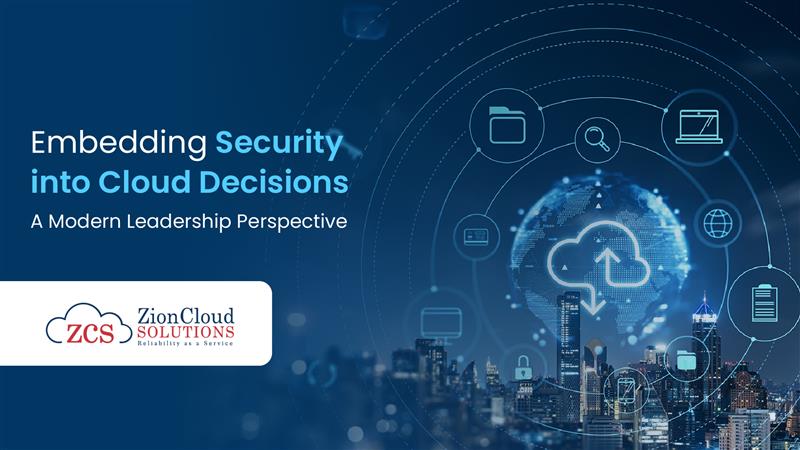
Cloud adoption has fundamentally reshaped how organizations build, scale, and operate digital systems. It has enabled speed, flexibility, and innovation at a scale that was once difficult to achieve with traditional infrastructure. But as cloud environments grow in complexity, one reality is becoming increasingly clear — security can no longer be treated as a technical checkpoint that sits at the end of implementation cycles.
Security today must be part of the decision-making fabric itself.
For leadership teams, this shift represents more than a change in tooling or policy. It reflects a broader transformation in how organizations think about trust, risk, agility, and resilience. Embedding security into cloud decisions is not just about protecting systems; it is about enabling businesses to innovate confidently, scale responsibly, and operate with long-term stability.
Security Is No Longer a Layer — It Is a Lens
Traditionally, security was often viewed as an additional layer applied after systems were designed or deployed. This model worked reasonably well when infrastructure was static, applications were monolithic, and release cycles were predictable. In cloud environments, however, that approach quickly becomes insufficient.
Modern cloud ecosystems are dynamic by nature. Infrastructure is provisioned automatically. Applications are built using distributed architectures. Development teams release updates continuously. Data flows across services, regions, and platforms in real time.
In such environments, applying security as an afterthought introduces friction and vulnerability. Instead, organizations are recognizing the need to treat security as a guiding lens through which architectural, operational, and business decisions are made.
When security becomes a lens rather than a layer, it influences how systems are designed, how workloads are distributed, and how data is managed. It helps teams anticipate risks instead of reacting to them. More importantly, it supports innovation by creating guardrails that allow teams to move faster without compromising integrity.
Leadership’s Role in Security-Driven Cloud Decisions
While security teams and engineers implement technical safeguards, the mindset required for security-by-design must originate at the leadership level. Decisions about architecture, technology investments, vendor partnerships, and operational priorities are shaped by executive direction. When leadership views security as a strategic enabler rather than a compliance requirement, it influences how teams across the organization approach cloud adoption.
Modern leaders understand that security is closely tied to customer trust and brand credibility. A secure cloud environment protects sensitive information, ensures service availability, and supports regulatory compliance. But beyond these fundamentals, it also creates an environment where innovation can thrive without constant fear of disruption.
Embedding security into decision-making means asking different questions at the earliest stages of cloud initiatives. Leaders begin evaluating how new platforms will handle identity management, data encryption, access governance, and monitoring capabilities before deployment begins. They encourage cross-functional collaboration between security, engineering, and business teams, ensuring that security requirements are aligned with business objectives rather than treated as isolated constraints.
Designing Cloud Architectures That Anticipate Risk
One of the most significant shifts in cloud security is the move from reactive controls to proactive architectural planning. Instead of relying on perimeter defenses or post-deployment audits, organizations are designing cloud systems that inherently minimize exposure and reduce potential attack surfaces.
This architectural perspective involves thoughtful segmentation of workloads, structured access controls, and automated monitoring mechanisms that operate continuously. It ensures that each component of the system functions within clearly defined boundaries while maintaining seamless integration with the broader ecosystem.
Cloud platforms offer native security capabilities that support this approach, including identity management frameworks, automated compliance checks, and real-time threat detection. However, the effectiveness of these tools depends heavily on how they are integrated into system design. Security-focused architectures leverage these capabilities from the beginning, ensuring they become part of operational workflows rather than external add-ons.
When organizations design systems that anticipate risk, they also reduce operational complexity. Security processes become automated and predictable, allowing teams to focus more on delivering value and less on managing vulnerabilities.
The Intersection of Speed and Security
A common misconception in cloud transformation is that security slows down development and innovation. In reality, the opposite is often true when security is embedded into decision frameworks.
Organizations that integrate security early in the development lifecycle experience fewer disruptions later. Secure coding practices, automated vulnerability scanning, and consistent policy enforcement reduce the likelihood of last-minute redesigns or emergency patches. As a result, teams can release updates more confidently and maintain consistent delivery timelines.
This alignment between speed and security is particularly important in environments that rely on continuous integration and continuous deployment (CI/CD). When security checks are automated and integrated into development pipelines, they become part of the natural development rhythm. Engineers receive immediate feedback, and potential risks are addressed before they reach production environments.
Leadership plays a crucial role in enabling this balance by investing in tools, training, and processes that support secure development practices. More importantly, they foster a culture where security is seen as a shared responsibility rather than the sole domain of specialized teams.
Governance Without Friction
Cloud environments often involve multiple services, platforms, and geographic regions. Managing governance across these distributed ecosystems requires clarity and consistency. Traditional governance models, which relied heavily on manual oversight and rigid controls, struggle to keep pace with the fluid nature of cloud operations.
Modern governance approaches focus on establishing policies that are automated, scalable, and adaptable. These policies define how resources are provisioned, how data is accessed, and how compliance requirements are maintained across environments. Automation ensures these standards are applied consistently, reducing human error while maintaining operational efficiency.
Embedding governance into cloud decisions allows organizations to maintain compliance without slowing down innovation. It ensures that new services and applications are deployed within predefined security frameworks, eliminating the need for repetitive audits or manual verification processes.
This governance model also supports transparency. Leaders gain visibility into security posture across cloud environments, enabling informed decision-making and proactive risk management.
Security as a Cultural Commitment
Technology alone cannot establish a security-by-design mindset. Organizational culture plays an equally important role. Teams must understand that security is not simply a technical requirement but a fundamental component of delivering reliable digital experiences.
Cultivating this culture involves education, collaboration, and shared accountability. Development teams need visibility into how their design choices affect system security. Operations teams require tools that simplify monitoring and response processes. Business leaders must understand how security investments contribute to long-term growth and customer confidence.
Organizations that successfully embed security into their culture often find that it enhances collaboration across departments. Security discussions become part of strategic planning rather than isolated technical reviews. This cultural alignment ensures that security remains a priority even as technologies evolve and business goals shift.
Preparing for the Future of Cloud Security
As cloud technologies continue to evolve, security challenges will grow in complexity. The rise of distributed applications, artificial intelligence, and edge computing introduces new considerations for data protection and system integrity. Organizations that treat security as a foundational decision framework will be better positioned to adapt to these changes.
Future-ready cloud security strategies emphasize flexibility and continuous improvement. They incorporate advanced monitoring tools, predictive threat detection, and adaptive access controls that evolve alongside system architecture. More importantly, they rely on leadership commitment to ensure security remains aligned with organizational priorities.
Security by design is not a one-time initiative. It is a continuous practice that evolves with technology, business models, and regulatory landscapes. Leaders who recognize this reality can create cloud environments that support innovation while maintaining resilience.
A Leadership Imperative
Embedding security into cloud decisions represents a fundamental shift in how organizations approach digital transformation. It moves security from the margins of implementation into the center of strategic planning. It ensures that innovation is supported by trust, agility is reinforced by stability, and growth is sustained by responsible risk management.
For modern leaders, this approach is becoming less of an option and more of a necessity. Cloud platforms are no longer just infrastructure solutions; they are ecosystems that drive business value and customer experience. Protecting these ecosystems requires intentional design, collaborative culture, and strategic foresight.
Organizations that embrace this leadership perspective will not only strengthen their security posture but also unlock greater confidence in their ability to innovate and scale. By embedding security into every cloud decision, they create digital environments that are resilient, adaptable, and prepared for the future.
Conclusion: Turning Security Vision into Cloud Reality
Embedding security into cloud decisions is no longer just a technical evolution — it is a leadership commitment to building digital environments that are resilient, scalable, and trusted. As organizations continue to modernize their infrastructure and accelerate innovation, security must remain closely aligned with architecture, operations, and long-term business strategy.
At Zion Cloud Solutions, we believe that security becomes most effective when it is thoughtfully integrated into every stage of the cloud journey — from initial design and migration planning to continuous optimization and governance. Our approach focuses on helping organizations build cloud environments where security supports agility rather than restricting it, enabling teams to innovate with confidence while maintaining strong compliance and reliability standards.
By combining architectural expertise, cloud-native security frameworks, and a deep understanding of evolving business needs, ZCS works alongside organizations to design cloud ecosystems that remain secure as they scale and adapt. Because in modern cloud environments, security is not simply about protection — it is about enabling sustainable growth, operational confidence, and long-term digital trust.