For nearly a decade, the Modern Data Stack shaped how organizations approached analytics and data engineering. Cloud data warehouses, SaaS ingestion tools, transformation frameworks, and BI platforms promised speed, scalability, and flexibility. And for a time, they delivered.
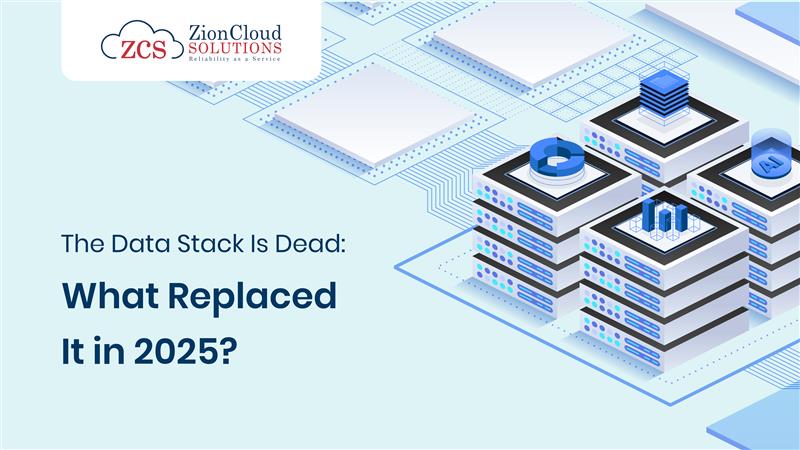
But by 2025, a growing number of enterprises reached the same conclusion: the modern data stack, as originally designed, no longer meets the demands of today’s data and AI-driven businesses.
This wasn’t a sudden collapse, but it was a gradual realization that the assumptions behind the stack no longer hold.
Why the Modern Data Stack Stopped Working
The modern data stack was built on composability. Each layer could be swapped, upgraded, or replaced independently. In theory, this allowed teams to move faster and adopt innovation quickly.
In reality, stacks grew complex and fragile.
Organizations found themselves managing sprawling ecosystems of tools, each with its own configuration, metadata model, security rules, and operational quirks. Pipelines became harder to reason about. Debugging failures meant jumping across multiple systems. Ownership blurred, and trust in data outputs slowly eroded.
More importantly, the stack optimized for analytics production, not decision production. It was designed to generate dashboards, not to support real-time intelligence or autonomous systems.
That gap became impossible to ignore in 2025.
What Changed in 2025
The turning point wasn’t just tool fatigue; it was a fundamental shift in how data is used.
By 2025, AI moved decisively from experimentation into core business workflows. Enterprises began deploying copilots, recommendation engines, forecasting systems, and automation powered directly by data platforms. These systems required data that was not only accurate, but timely, contextual, and explainable.
At the same time, how people interacted with data changed. Business users increasingly expected to ask questions in natural language and receive clear, consistent answers. They weren’t interested in where data lived or how it was transformed, they expected the system to understand intent.
Traditional modern data stacks weren’t built for this. They lacked a shared semantic foundation and depended heavily on human intervention to operate, validate, and interpret data.
The result was a growing mismatch between what businesses needed and what the stack could deliver.
From a Stack of Tools to an Intelligent Data System
What replaced the modern data stack in 2025 is not a single product or architecture. It is a shift in mindset.
Organizations are moving away from loosely connected tools and toward intelligent, integrated data systems, platforms designed to manage data end-to-end, with built-in understanding of context, quality, and usage.
These systems don’t just move and transform data. They observe it, reason about it, and increasingly act on it.
Agentic Behaviour Becomes Core
One of the most defining changes in 2025 is the emergence of agentic capabilities inside data platforms.
Instead of static pipelines that fail silently or require manual monitoring, modern platforms embed AI agents that can detect anomalies, trace lineage, identify root causes, and recommend or execute corrective actions. This turns data operations from a reactive process into a proactive, self-improving system.
As data ecosystems grow larger and more real-time, this level of autonomy becomes essential rather than optional.
Semantics Move to the Centre
Another major shift is the elevation of semantics from an afterthought to foundational infrastructure.
In 2025, it became clear that AI and analytics are only as effective as the business meaning they operate on. Metric definitions, entity relationships, and business logic can no longer live in documentation or individual dashboards. They must be embedded directly into the platform.
A strong semantic layer enables consistent answers, trusted AI outputs, and meaningful natural-language interaction with data. Without it, speed only amplifies confusion.
Consolidation Over Composition
The era of assembling a data stack from dozens of point solutions is giving way to consolidation.
Modern platforms now integrate ingestion, transformation, governance, analytics, and AI capabilities more tightly. This reduces operational overhead, simplifies security, and ensures metadata and lineage remain consistent across the system.
The goal is no longer flexibility at any cost, but reliability, clarity, and speed of insight.
What This Means Going Forward
Declaring the modern data stack “dead” doesn’t mean its ideas were wrong, it means they were incomplete.
The next generation of data platforms is designed around intelligence, not just infrastructure. They are built to support real-time decisions, AI-driven workflows, and continuous adaptation. Data is no longer something teams prepare and hand off; it is something systems actively reason over.
Organizations that embrace this shift are not just modernizing their data architecture; they are redefining how decisions get made.
A ZCS Perspective
We see this transition playing out across enterprises rethinking their data foundations for an AI-first future. The most successful teams are moving beyond tool-centric thinking and investing in intelligent, integrated data systems that can scale with both data growth and business ambition.
The modern data stack didn’t simply disappear in 2025. It evolved into something more autonomous, more contextual, and far more aligned with how organizations actually use data today.
And that evolution is just getting started.