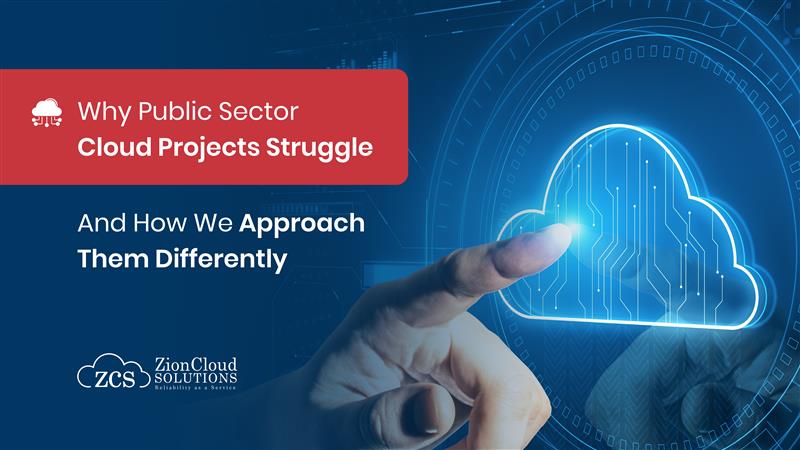
Cloud modernization in the public sector is rarely about adopting the newest technology. More often, it’s about continuity keeping essential services running while systems evolve, regulations change, and public expectations increase.
Over the years, working alongside public institutions, Zion Cloud Solutions has seen a clear pattern: success doesn’t come from speed or scale alone. It comes from understanding the realities of government environments and designing cloud strategies that respect them.
This article shares what actually makes public sector cloud modernization challenging and how a thoughtful, grounded approach leads to better outcomes.
Public Sector Cloud Is a Different Environment – By Design
Government systems exist to serve people, not markets. That distinction matters.
Unlike private enterprises, public sector organizations must operate within:
- Fixed budget cycles
- Strict procurement processes
- Regulatory and audit requirements
- Long-standing legacy platforms
- Limited tolerance for downtime
These constraints aren’t obstacles; they are safeguards. Any cloud strategy that ignores them is likely to create friction instead of progress.
Cloud modernization in this space must adapt to the environment, not attempt to overwrite it.
The Real Complexity Isn’t Technology – It’s Responsibility
From the outside, public sector cloud projects are often described as “complex” due to legacy systems or compliance requirements. In reality, the deeper challenge is shared responsibility.
Public institutions manage:
- Sensitive citizen data
- Critical services (health, safety, utilities, finance)
- Interdependent systems across departments and agencies
A cloud decision in one area often has ripple effects elsewhere. That’s why modernization must be deliberate, not disruptive.
At Zion Cloud Solutions, the first question is never “What cloud service should we use?”
It’s “What must not break?”
Incremental Progress Beats Big-Bang Transformation
One of the most effective lessons from public sector work is that incremental modernization outperforms large, one-time transformations.
Rather than replacing everything at once, successful initiatives often:
- Modernize specific workloads with clear value
- Establish secure cloud landing zones
- Gradually integrate legacy systems
- Improve visibility, monitoring, and governance early
This approach builds confidence within internal teams and allows institutions to learn, adjust, and scale responsibly.
Cloud modernization becomes a program, not a project.
Security and Compliance Are Design Inputs, Not Afterthoughts
In public sector environments, security is not a feature it’s a foundation.
Compliance frameworks, audit readiness, and data governance must be built into the architecture from day one. Retrofitting controls later introduces risk and delays.
Zion Cloud Solutions approaches this by:
- Designing compliance-aligned architectures upfront
- Implementing least-privilege access models
- Ensuring audit visibility across environments
- Embedding security monitoring into daily operations
The result is a cloud environment that supports innovation without compromising trust.
Cloud Success Depends on the People Operating It
Technology alone does not modernize institutions, people do.
Public sector IT teams often manage:
- High workloads
- Lean staffing
- Deep institutional knowledge
- Systems that cannot afford downtime
Cloud strategies that assume unlimited time or resources rarely succeed.
That’s why Zion focuses on:
- Simplifying operations, not adding tools
- Aligning cloud designs with existing team skills
- Providing clear documentation and handover
- Supporting gradual adoption rather than forced change
When internal teams feel supported instead of replaced, modernization gains momentum.
Better Outcomes Come From Better Questions
Public sector cloud projects succeed when the right questions are asked early:
- Which services are mission-critical?
- What data carries the highest risk?
- Where do performance and availability matter most?
- How will this environment be governed long-term?
Zion Cloud Solutions brings structure to these conversations, helping institutions define priorities before technology decisions are made.
The outcome is clarity not complexity.
A Practical Definition of “Success” in Public Sector Cloud
In the public sector, success rarely looks like dramatic transformation headlines. Instead, it looks like:
- Systems that are more resilient
- Faster recovery during incidents
- Clearer visibility for audits
- Reduced operational strain on teams
- Gradual improvements to citizen-facing services
These outcomes may not always be flashy but they are meaningful and they last.
Moving Forward With Confidence
Cloud modernization in the public sector is not about moving faster than everyone else. It’s about moving deliberately, responsibly, and sustainably.
For us the focus remains consistent:
- Respect the mission
- Understand the constraints
- Design for continuity
- Build for the long term
When cloud strategies align with public service realities, modernization becomes not just possible but dependable.
Final Thought
Public sector cloud modernization works best when it’s treated as a partnership, not a transaction. With the right approach, cloud becomes a tool for resilience, transparency, and long-term service improvement not disruption.