Have you ever been in a meeting where a simple business question comes up? Everyone knows the answer should exist somewhere in the data, but can no one get to it immediately?
Well, it happens more often. A number appears on the dashboard, someone immediately questions the change, another person opens a report, while someone else starts checking a different sheet, and the discussion slowly shifts from decision-making to searching for information. Even with strong reporting systems in place, the gap between having data and getting a clear answer can still slow down important conversations.
This is exactly where Microsoft Fabric Data Agents are beginning to change the experience. Instead of making users move through multiple reports or depend on technical teams for every follow-up question, they allow business questions to be asked more naturally and answered directly through connected enterprise data.
What makes this shift important is not only speed, but the way it changes how people interact with analytics. When answers become easier to access, data starts supporting decisions in real time rather than after the discussion has already moved on.
Why business questions still take too long to answer
Most organizations today are not struggling because they lack data. In fact, many already have dashboards, reports, warehouses, and multiple systems capturing information every day. The challenge is that these systems often answer only the questions they were originally designed for.
The moment a discussion moves beyond predefined reporting, delays begin to appear. A leadership team may notice that revenue has shifted in one region, but understanding the reason behind that shift usually requires more than one dashboard. A finance team may see cost movement but still need to identify which exact category caused it. An operations team may spot delays but still struggle to isolate where the bottleneck started.
What Microsoft Fabric data agents change
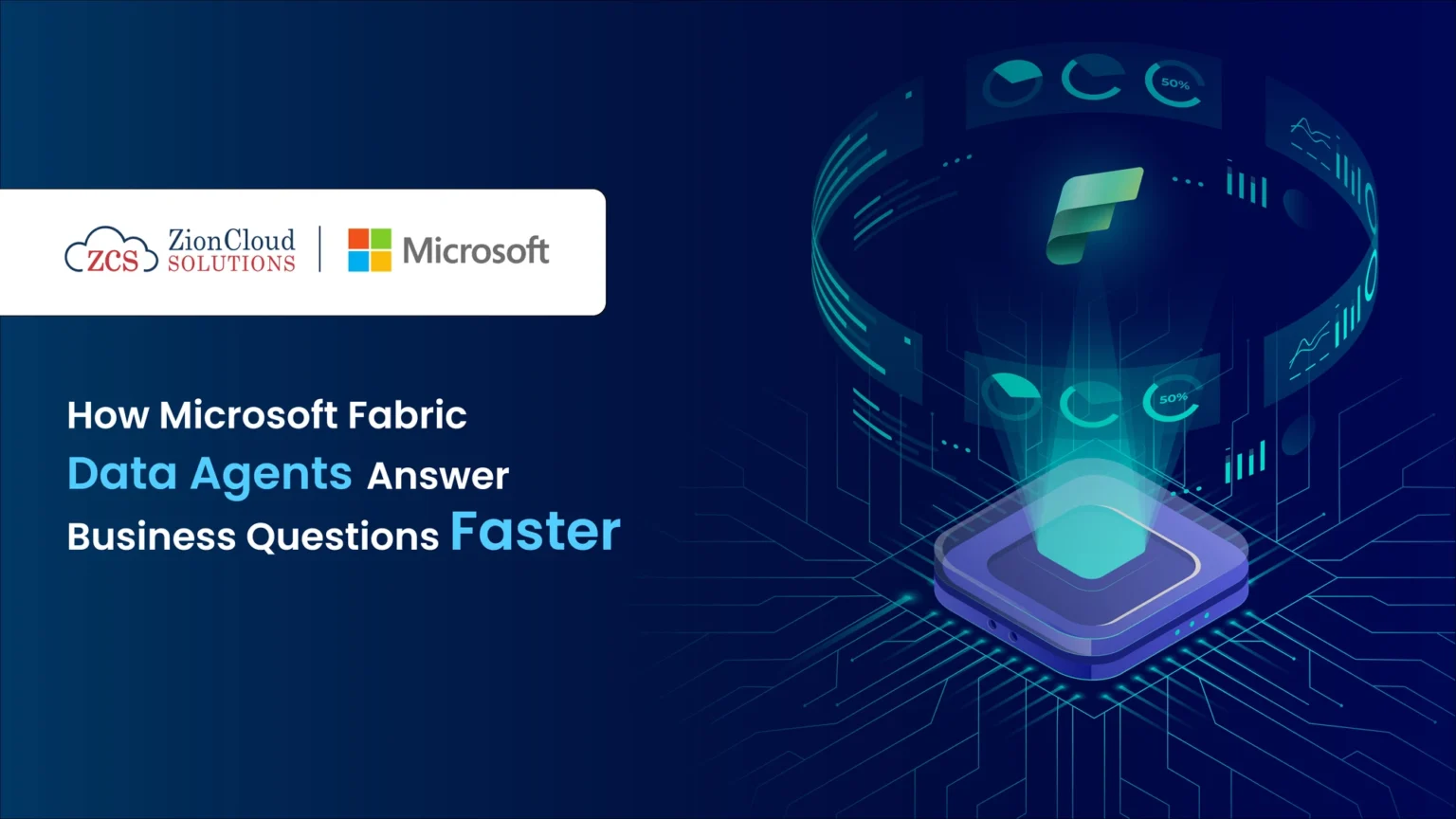
Microsoft Fabric Data Agents introduce a more conversational way of interacting with enterprise data. Instead of expecting users to understand where data lives or how reports are structured, they allow questions to begin in plain business language.
A business user can ask why a product category underperformed last month, which region showed unusual growth, or where process delays increased this week. The system interprets the intent behind the question, connects it to the available data model, and returns an answer based on what already exists inside the Fabric environment. What makes this valuable is that the interaction starts with the business question itself, not with report navigation. That small change significantly reduces the effort required to move from curiosity to clarity.
How the experience feels different inside Microsoft Fabric
Because Microsoft Fabric already connects storage, analytics, governance, and semantic models in one environment, Data Agents are able to work with context that already exists across enterprise datasets.
When a question is asked, the system does not simply search for matching terms. It understands relationships between business entities, recognizes definitions that already exist in semantic models, and uses that context to generate a meaningful answer.
This is why the response feels more aligned with how business users think. Instead of receiving technical output, they receive information in a form that can immediately support a discussion or decision. That difference matters because analytics adoption often depends on how easily non-technical users can trust and interpret what they see.
Why this matters more during real business conversations
The strongest value of Data Agents appears in moments where speed matters most. Business meetings often move quickly, and questions rarely stop at the first metric shown on a screen.
A sales review may begin with overall numbers but immediately move toward understanding why one region changed more than another. A finance discussion may begin with quarterly variance but quickly shift toward identifying what caused the difference. A supply chain of conversation may require immediate visibility into repeated operational delays.
Without conversational access to data, those moments often create pauses. Someone promises to check later; another report gets requested, and the discussion loses momentum. Data Agents reduce that interruption by making it easier to continue asking questions while the conversation is still happening.
Moving beyond dashboards without replacing them
Dashboards are still essential because they provide structured visibility into business performance. They help teams monitor known indicators consistently and create a shared reporting baseline.
However, dashboards are naturally built around expected questions. Business conversations are not always predictable. The moment someone asks why a number changed, what influenced it, or whether a pattern exists elsewhere, the dashboard often becomes the starting point rather than the full answer.
This is where Data Agents extend the reporting experience rather than replace it. They help users move beyond what is visible on the first screen and continue exploring the meaning behind the numbers. That creates a more natural flow between reporting and understanding.
Where Microsoft Fabric data agents can create immediate value
The practical use of Data Agents becomes clearer when viewed across business functions.
In sales, they help teams understand performance changes without building fresh report filters every time a new question comes up.
In finance, they make it easier to trace unusual movement in cost or revenue categories without relying entirely on scheduled analysis cycles.
In operations, they help identify recurring delays or exceptions by allowing managers to ask direct questions as situations evolve.
In publishing, media, or rights-based environments, they can support quick visibility into content status, rights timelines, approval flow, or asset movement when discussions require immediate answers.
The reason adoption feels natural is because the interaction follows the way people already think and speak during business reviews.
Why data quality still determines success
Even with advanced AI capability, the reliability of answers always depends on the quality of the data underneath. If business definitions are inconsistent, if metadata is weak, or if semantic models are incomplete, responses may lose clarity.
That is why organizations using Microsoft Fabric effectively still need strong data discipline. Data Agents perform best when business definitions are already trusted across teams. The stronger the semantic foundation, the stronger the confidence in conversational answers.
This is also why AI in analytics does not remove the need for governance. It increases the importance of getting governance right.
The bigger shift happening in analytics
Analytics is gradually moving from static reporting toward guided understanding.
Earlier, the main objective was to build reports that showed what happened. Today, business users increasingly expect systems that help explain why something happened and what to explore next. That expectation is driving more attention toward conversational analytics across enterprise platforms.
Microsoft Fabric Data Agents fit this shift because they reduce friction between question and insight. Instead of treating analytics as something users visit occasionally, they make it part of active decision-making.
That changes analytics from being report-driven to interaction-driven.
Final Thought
The real strength of enterprise data is not only in how much information an organization stores, but in how quickly that information becomes useful when questions arise.
That is exactly where Microsoft Fabric Data Agents create practical value by bringing business language closer to enterprise intelligence. When answers arrive naturally and quickly, analytics becomes more practical, more accessible, and more valuable during the moments when decisions are actually being made.
At ZCS, we see this as an important direction for modern analytics, helping businesses move beyond static reporting toward data experiences where questions can be answered faster, decisions can happen with greater confidence, and enterprise intelligence becomes easier for business teams to use.