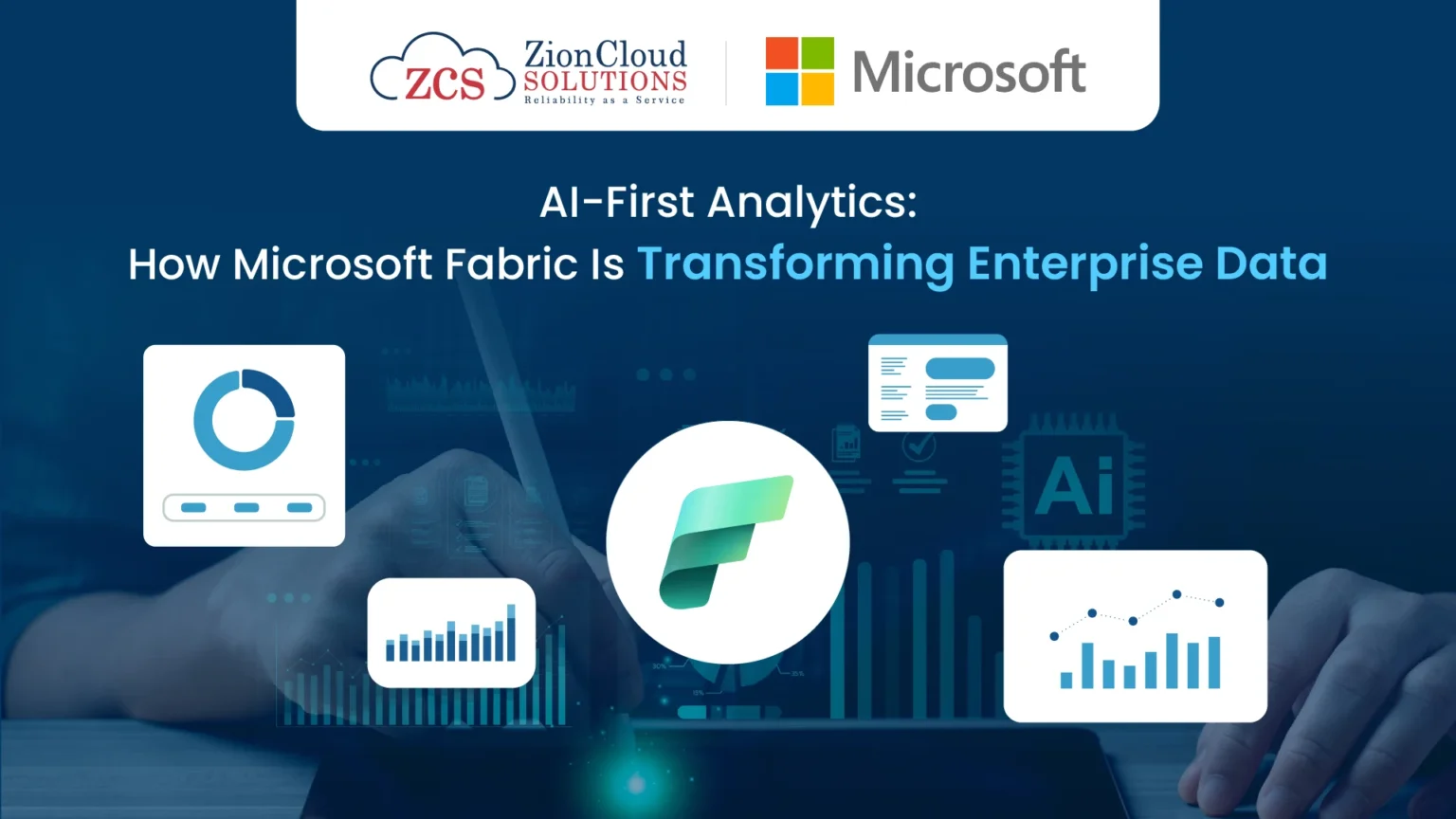
For years, enterprise analytics has been treated like a complex puzzle, data scattered across systems, dashboards multiplying without clarity, and insights locked behind technical barriers. Therefore, leaders wanted answers, but often had to wait for days, weeks, or entire reporting cycles to get them. Today, that model is breaking down. It’s no longer about how much data companies have; it’s about how fast they can act on it. This is where AI-first analytics, powered by Microsoft Fabric, is reshaping the future.
Microsoft Fabric represents a fundamental shift in how organizations think about data. Instead of layering artificial intelligence on top of traditional analytics, Fabric is built with AI at its core. The result is a unified, intelligent analytics platform that connects data, insights, and action in ways that feel natural, scalable, and surprisingly simple.
From fragmented analytics to a unified intelligence layer
One of the biggest challenges enterprises face today is fragmentation. Data lives in multiple warehouses, data lakes, BI tools, and operational systems. Each layer introduces latency, duplication, and governance complexity. Microsoft Fabric addresses this by unifying data engineering, data science, real-time analytics, and business intelligence into a single SaaS platform.
At the heart of Fabric is OneLake, a single logical data lake that eliminates the need for constant data movement. Instead of copying data across systems, teams work from a shared foundation. This dramatically reduces operational overhead while improving consistency, security, and performance. From an SEO and business perspective, this unification is what makes Microsoft Fabric a true enterprise analytics platform, rather than just another data tool.
AI that works where your data lives
What makes Microsoft Fabric truly AI-first is how deeply intelligence is embedded into the analytics lifecycle. Rather than requiring data teams to export datasets into separate AI platforms, Fabric allows machine learning and generative AI to operate directly on enterprise data.
With Copilot in Microsoft Fabric, users can interact with data using natural language. Business users can ask questions in plain English, generate reports automatically, or explore trends without writing a single line of SQL or DAX. This significantly lowers the barrier to analytics and democratizes data access across the organization.
For technical teams, Fabric supports advanced data science workflows, including model training, experimentation, and deployment, all within the same ecosystem. This tight integration ensures that AI insights are not theoretical experiments, but production-ready capabilities that drive real business outcomes.
Real-time insights for real-time decisions
Traditional analytics often struggle with timeliness. By the time insights reach decision-makers, the opportunity has already passed. Microsoft Fabric changes this by enabling real-time analytics across streaming and operational data.
Whether it’s monitoring supply chains, tracking customer behavior, or detecting anomalies, Fabric allows enterprises to react as events unfold. AI models can continuously learn from incoming data, providing proactive alerts and recommendations rather than static reports. This shift from retrospective reporting to predictive and prescriptive analytics is a defining characteristic of AI-first enterprises.
Governance, security, and scale; built in, not bolted on
One common concern with AI-driven analytics is governance. As data access becomes easier, how do organizations maintain control, compliance, and trust? Microsoft Fabric addresses this by embedding governance into the platform itself.
Because Fabric is natively integrated with Microsoft Azure and Microsoft Purview, enterprises can enforce consistent data policies, lineage tracking, and access controls across all analytics workloads. AI models operate within these boundaries, ensuring that innovation does not come at the cost of security or regulatory compliance.
This makes Fabric especially attractive for large enterprises operating in regulated industries, where trust and transparency are just as important as speed and innovation.
Why AI-first analytics matters now
The shift to AI-first analytics is not a future trend; it’s a present necessity. Enterprises are dealing with unprecedented data volumes, faster market cycles, and rising expectations for personalization and efficiency. Legacy analytics approaches cannot be kept up.
Microsoft Fabric enables organizations to move from descriptive analytics to decision intelligence. Instead of asking what happened, businesses can understand why it happened, what is likely to happen next, and what action should be taken. This capability is becoming a competitive differentiator, not a nice-to-have feature.
The business impact of Microsoft Fabric
Organizations adopting Microsoft Fabric are seeing tangible benefits: reduced time to insight, lower data management costs, improved collaboration between technical and business teams, and faster AI adoption. More importantly, they are building analytics ecosystems that evolve with their needs rather than breaking under scale.
By combining data engineering, AI, and business intelligence into a single platform, Fabric allows enterprises to focus less on plumbing and more on outcomes. That shift from managing data to leveraging intelligence is the real transformation.
The future belongs to AI-first enterprises
Microsoft Fabric is not just a tool; it represents a new operating model for enterprise analytics. An AI-first approach ensures that insights are accessible, timely, and actionable across the organization. As enterprises continue to embrace AI, platforms like Fabric will define how effectively data turns into value.
The question is no longer whether organizations should adopt AI-driven analytics, but how quickly they can make it part of their core decision-making process.
Ready to unlock AI-first analytics?
If your organization is looking to simplify data architecture, accelerate insights, and make AI a practical part of everyday decisions, Microsoft Fabric is the place to start. Now is the time to move beyond dashboards and build an analytics foundation that thinks, learns, and scales with your business.
Let your data do more than report the past and let it shape the future.