Real-Time Analytics — Why Companies Are Moving Beyond Monthly Reports
September 11, 2025 10:00 am - September 11, 2025 12:00 pm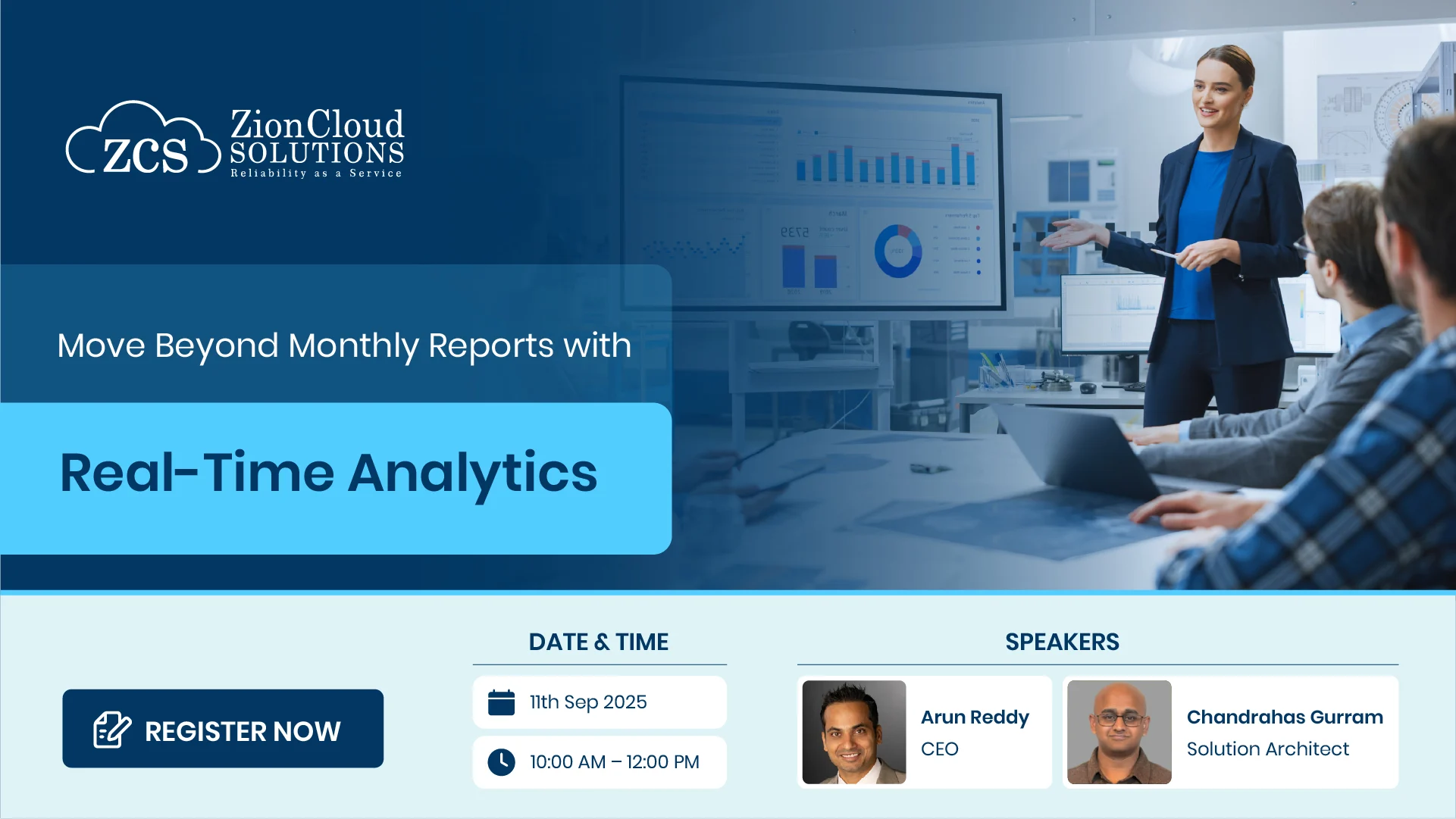
Move Beyond Monthly Reports with Real-Time Analytics
Overview
Traditional monthly or weekly reports – though widely used – often arrive too late to change outcomes. By the time numbers are reviewed, decisions have already been made, or damage control becomes difficult. Real-time analytics changes that dynamic. It consolidates live business metrics into one unified view — empowering teams to spot trends, detect problems, and act instantly before small issues turn into major setbacks.
In this session, we’ll explore how organizations adopt real-time analytics, what end-to-end streaming data setups look like, and how you can transition from static reporting to always-on, actionable insights.
What You Will Learn
-
Why traditional reporting creates blind spots — Understand how delayed reports can hide opportunities or escalate problems before anyone notices.
-
What real-time analytics really means — Learn how streaming / event-driven analytics differs from traditional batch processing or periodic reports.
-
How real-time dashboards increase accuracy and speed — See how live dashboards provide up-to-the-minute visibility into KPIs across sales, operations, support, finance, and more.
-
Basics of real-time data systems and architecture — Get introduced to the technical building blocks (data streaming, event processing, in-memory or stream-processing frameworks, real-time dashboards), and see what a working system looks like.
-
Practical business use cases across teams — From marketing, operations, finance to customer service — real-time analytics supports a wide variety of teams.
-
Simple steps to adopt real-time reporting in your organization — Guidance on how to begin the shift: define KPIs, choose data sources, set up streaming or event pipelines, create dashboards, and integrate workflows.
Why This Matters — The Power of Real-Time Analytics
-
Faster, more accurate decision-making — Since data is processed as soon as it’s generated (instead of waiting for periodic batches), you base decisions on current, accurate information.
-
Operational agility & responsiveness — Teams can detect issues or opportunities instantly — say, a sudden drop in sales, a glitch in sign-up flow, or a spike in customer complaints — and respond proactively.
-
Better customer experiences & personalization — Real-time analytics enables companies to react to customer behavior as it happens; for example, dynamically adjusting marketing campaigns, customizing offers, or responding to support needs.
-
Improved efficiency & reduced costs — From optimizing inventory in retail, to detecting fraud in finance, to predictive maintenance in manufacturing – real-time data helps avoid waste, reduce downtime, and streamline operations.
-
Competitive advantage and business agility — Firms using real-time analytics are better positioned to adapt quickly to market or operational changes – making them more resilient and forward-looking.
What a Real-Time Analytics Setup Looks Like (Architecture / Approach)
-
Data ingestion & streaming: Data flows in real time from various sources – transactional systems, user interactions, IoT sensors, logs, external feeds. Instead of waiting to batch and store, data is processed “as it arrives.”
-
Event or stream processing engine: Using tools or frameworks that support continuous processing – enabling filtering, transformation, enrichment, aggregation on streaming data.
-
Real-time / in-memory storage or data layer: For low latency reading and writing, ensuring dashboards and analytics queries return quickly.
-
Dashboard / visualization layer: Live dashboards that pull streaming data and present KPIs, trends, alerts — updating automatically as new data arrives.
-
Alerting & automation (optional): Based on rules or thresholds, alerting stakeholders (or triggering automated actions) instantly when important events happen — e.g. downtime, anomalies, spikes, thresholds crossed. This elevates real-time analytics to what some call Operational Intelligence (OI) — enabling real-time decision + action.
Simple Steps to Begin the Transition from Static Reporting to Real-Time Analytics
-
Define business objectives & KPIs — Decide what metrics matter most (sales-velocity, conversion rates, customer churn, site performance, supply-chain delays, etc.).
-
Catalog data sources — Inventory where data comes from: transactional systems, web/app events, logs, IoT, CRM, etc. Ensure you capture all relevant streams.
-
Design a streaming architecture — Set up pipelines/event streams (using stream-processing tools, in-memory/data-stream engines) instead of waiting for batch ETL.
-
Build real-time dashboards — Create intuitive dashboards customized to roles (executives, operations, marketing) so that insights are immediately visible.
-
Set up alerts / automated responses — Define thresholds or triggers so teams are notified (or automation kicks in) when specific events occur (e.g. drop in sales, system error, spike in returns).
-
Pilot & iterate — Start small (e.g. one department or use-case), test, refine dashboards and workflows, then scale gradually across organization.
-
Establish data governance & culture — Ensure data quality, privacy, security; build a culture that trusts and acts on real-time insights, not just retrospective reports.
About the Speakers
-
Arun Reddy, CEO — Brings strategic vision on how data-driven, real-time analytics can transform business operations and decision-making.
-
Chandrahas Gurram, Solution Architect — Skilled in designing scalable analytics and streaming data architectures. Will walk through the technical blueprint and practical implementation roadmap.
Why This Webinar from Zion Cloud Solutions
Zion Cloud Solutions specializes in data & analytics, cloud-based digital transformation, AI/ML, and consulting — meaning they understand both the business value and technical complexity behind data-driven change.
Through this webinar — “Real-Time Analytics — Why Companies Are Moving Beyond Monthly Reports” — they aim to help businesses break free from outdated reporting cycles and adopt modern, always-on analytics — improving agility, responsiveness and competitive edge.
Past Events
Explore More
IPHEC Vendor Show 2026
Illinois Public Higher Education Cooperative (IPHEC) Date: July 9, 2026 Location: Champaign, Illinois Event Overview We are excited to participate…

Scale with AI: Live + Labs – Irvine
Zion Cloud Solutions attended Google Cloud’s Scale with AI: Live + Labs in Irvine, California, where industry leaders, AI practitioners,…
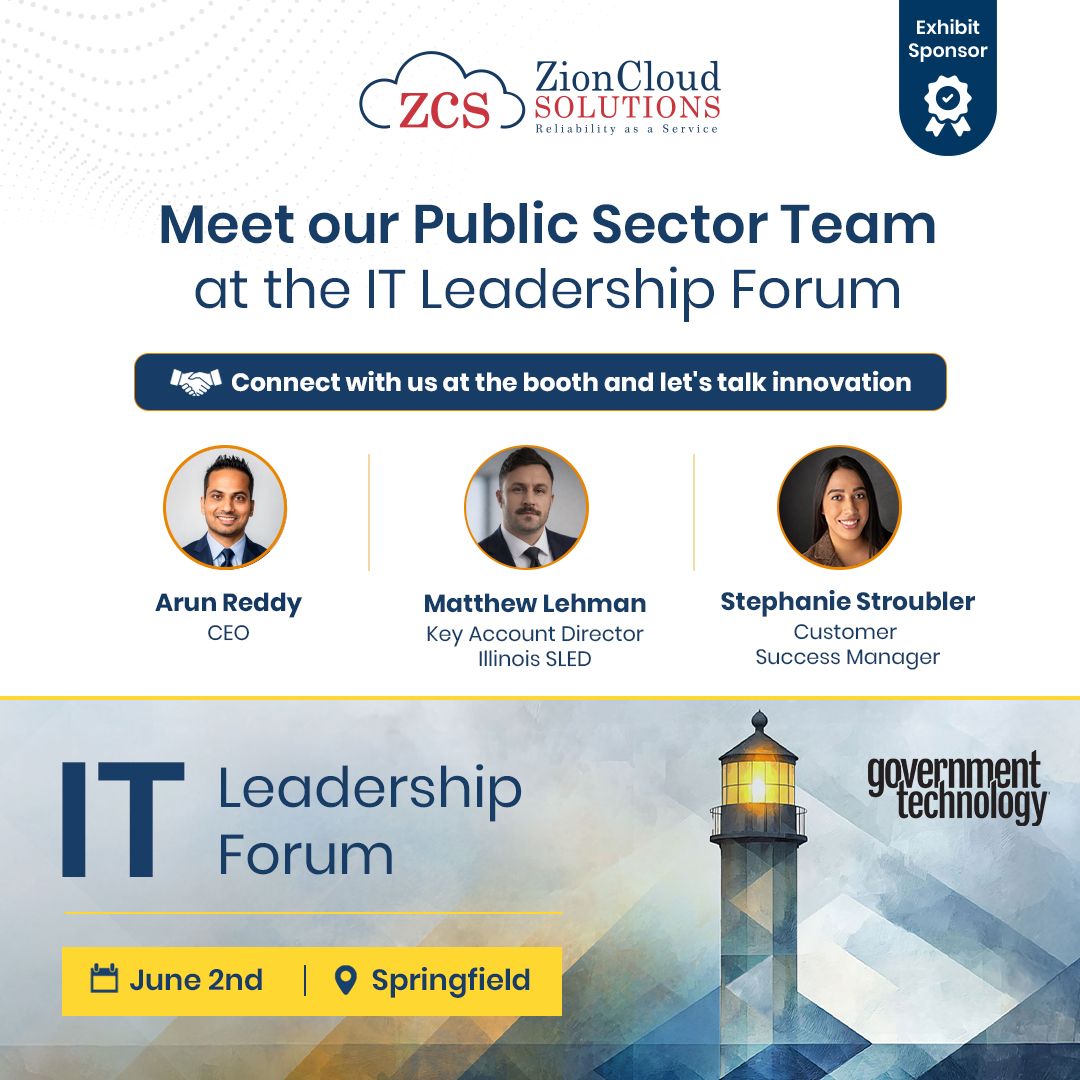
Illinois IT Leadership Forum 2026
Zion Cloud Solutions attended the Illinois IT Leadership Forum as an Exhibit Sponsor, connecting with state and local government leaders…